
VIA Terrazzo or Traditional Cast-in-Place Terrazzo? New Freedom for Refined Spaces.
Lime, sodium silicate and new material cycles: what really changes – and what matters in an Algarve villa.
A fine terrazzo floor is more than a patterned surface. It connects rooms, makes the material itself a design element and, when suitably executed, can later be refurbished. In high-quality Algarve homes in particular, it offers a compelling alternative to short-lived floor replacement: a bespoke finish planned around the architecture and how it will be used.
VIA introduces lime- and sodium-silicate-bound mixes, bespoke aggregates and recycled materials. This opens up new possibilities for villas, holiday homes and representative interiors. But does that automatically make this system better than conventional terrazzo? A fair comparison considers the binder, build-up, execution, design, maintenance and the full lifecycle – not just a green label.
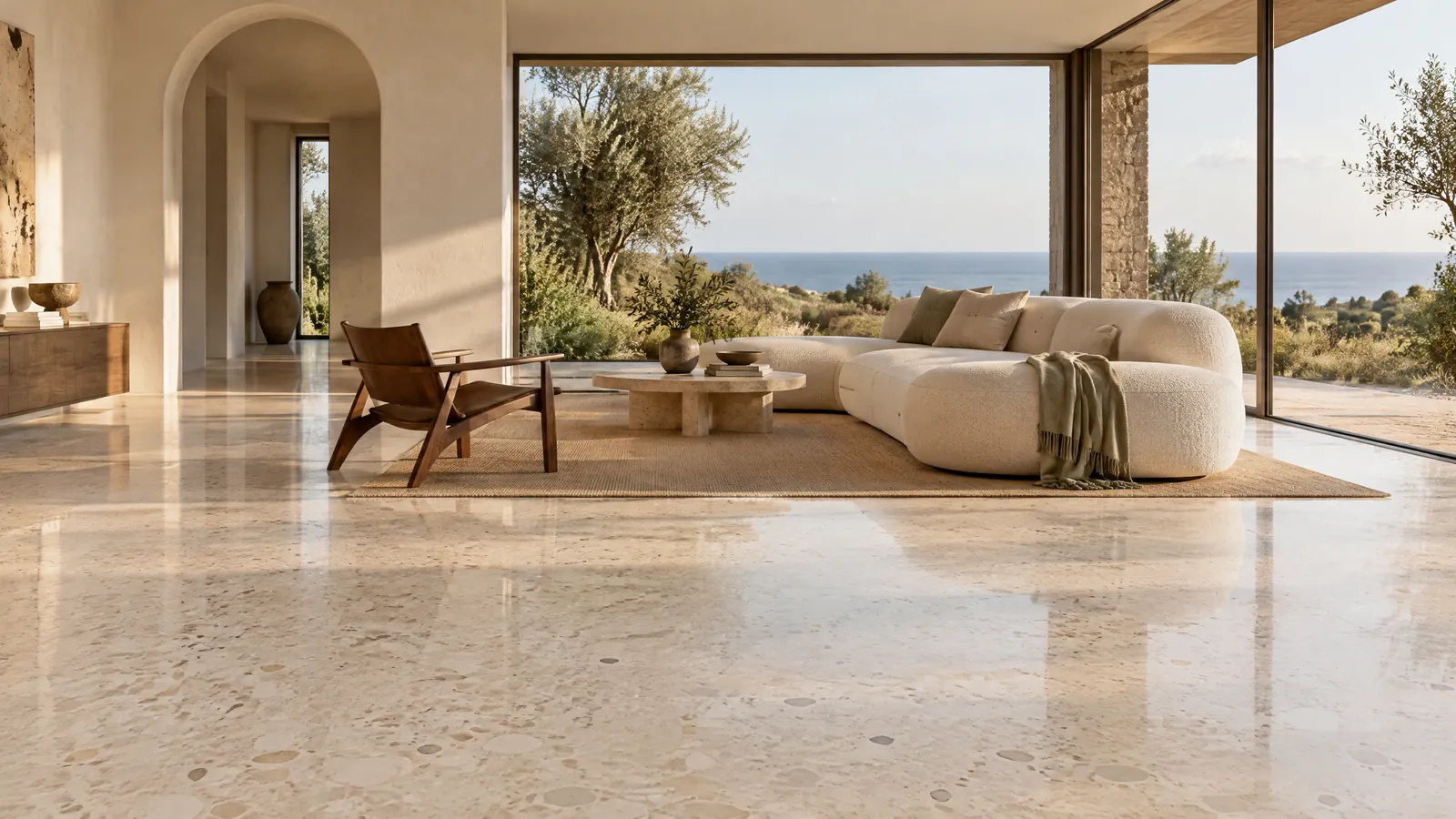
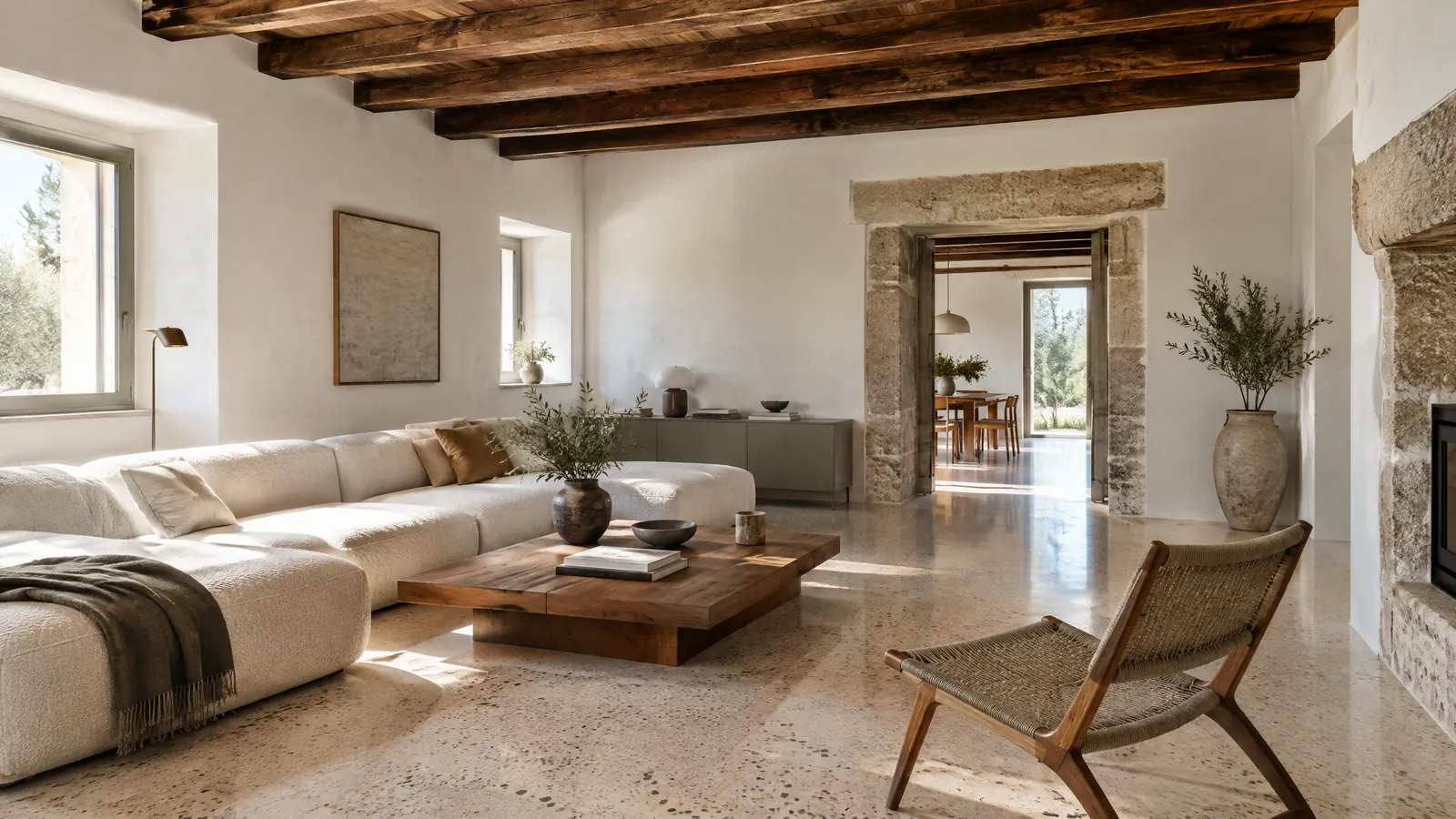
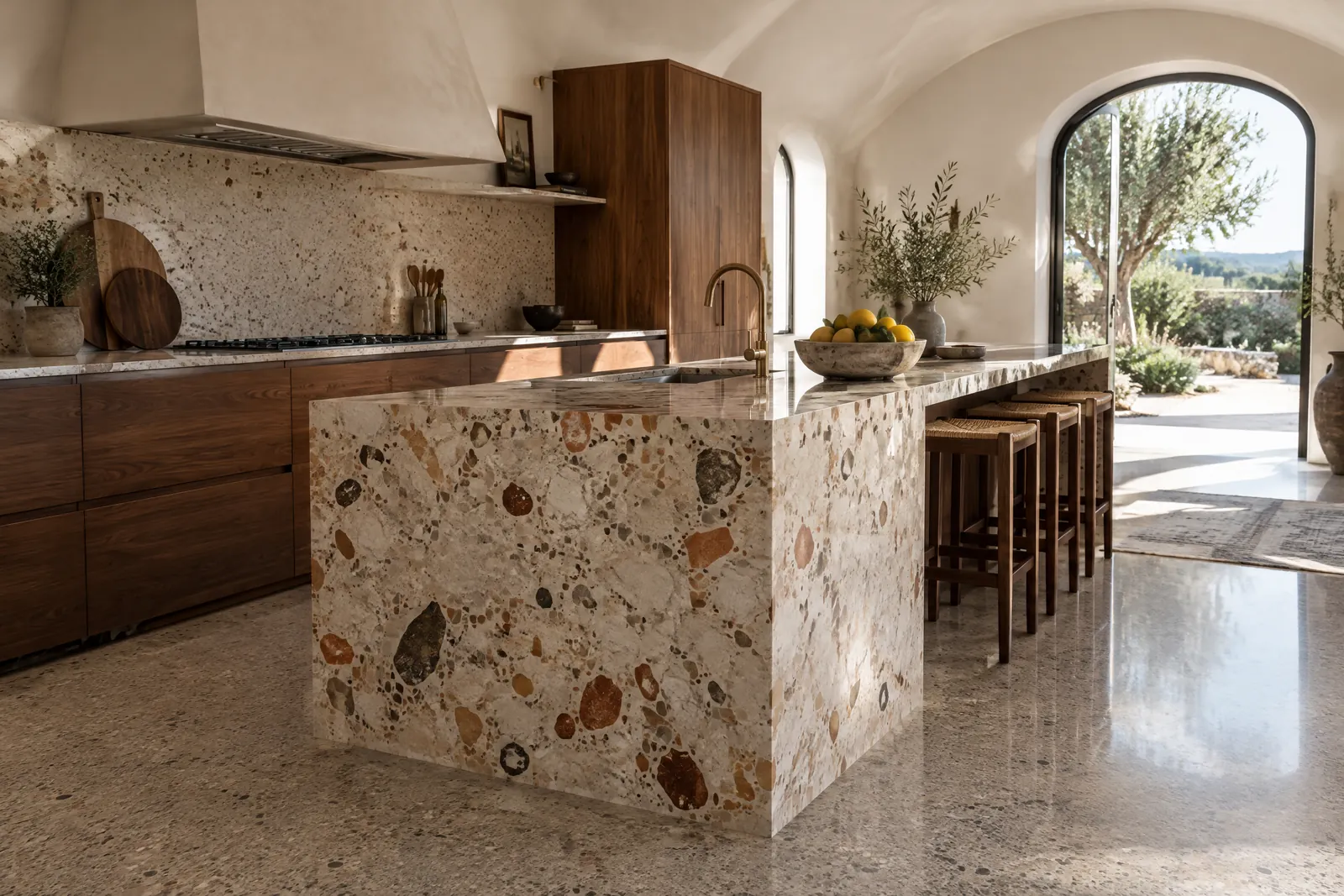
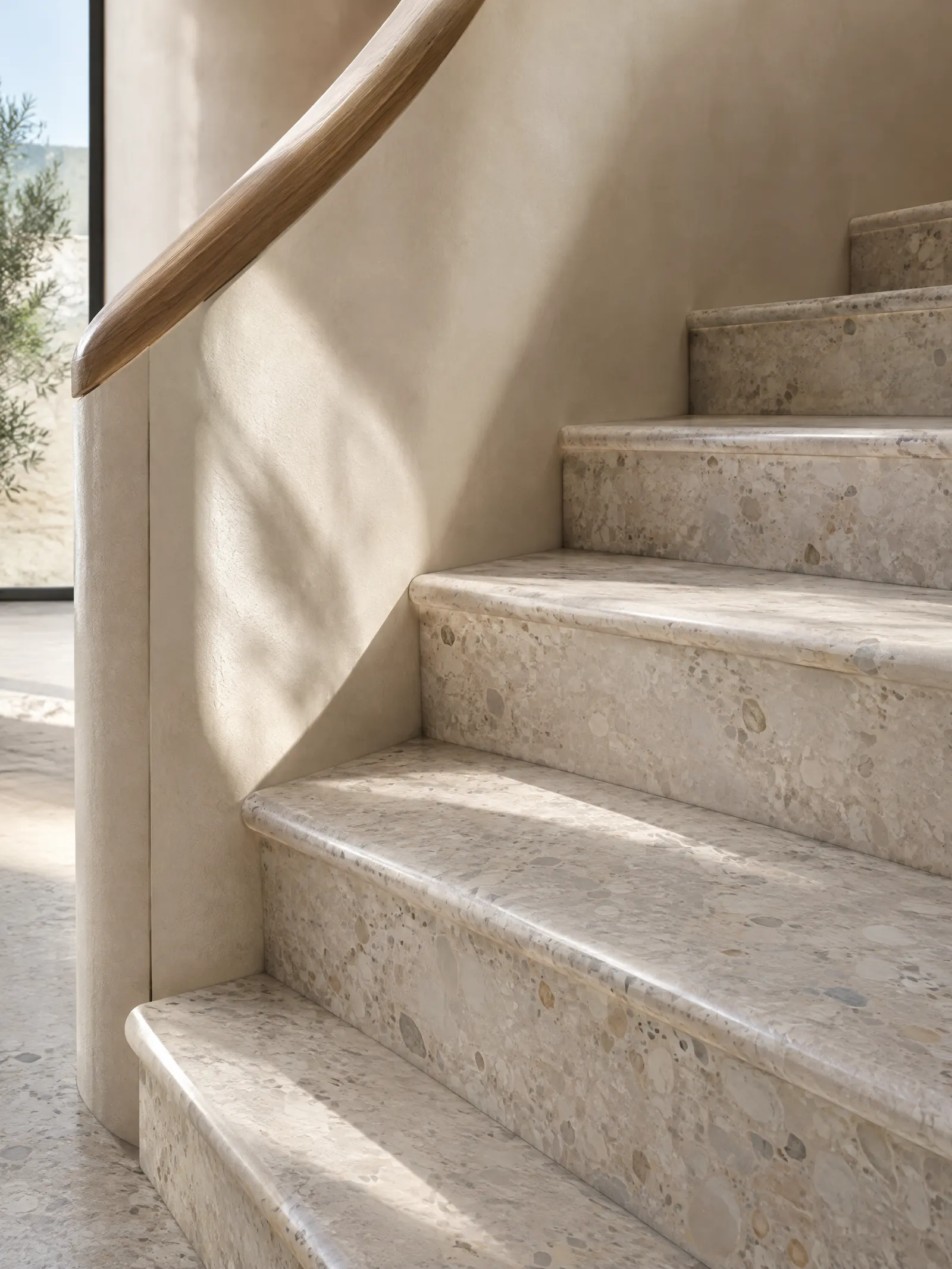
SteinWert offers new VIA terrazzo installations. This article is based on manufacturer documentation and specialist sources, not on an independent comparative laboratory test. All architectural images are AI-generated inspiration; they show neither documented SteinWert projects nor binding VIA product samples.
VIA and cement cast-in-place terrazzo: eight material differences that matter
| Criterion | VIA lime/sodium-silicate terrazzo | Traditional cement cast-in-place terrazzo |
|---|---|---|
| Binder | Lime binder, activated with sodium silicate (water glass); standard matrix free from cement and epoxy resin. [1][2] | Cement matrix with mineral aggregates; check the specific mix and additives. [4] |
| Finish and complete build-up | Thin variants are possible; for example, the data sheet describes a 10 mm application and approx. 7 mm after grinding removal. This is not a complete floor build-up. [2] | Several build-ups are available: NTMA describes, for example, an approx. 13 mm monolithic topping; bonded build-ups with an underbed are substantially thicker. [4] |
| Installation sequence | Dry grinding after approx. 24 h according to the data sheet; full use only after coordinated sign-off. [2] | Aftercare, curing and the start of grinding depend on the mix and construction; there is no universal construction period. [4] |
| Design | MyTerrazzo, tested bespoke aggregates, formed components and combined slab/cast details. [1] | Likewise offers bespoke aggregate grades, pigments, panels and divider strips; it is not limited to standard grey. [4] |
| Recycling | For recycled mixes, VIA typically states 50–60% or up to 60% recycled material; this is a mix-dependent manufacturer statement. [3] | Recycled aggregates and mineral recovery after removal are also possible; this is not an exclusive benefit of one binder class. [8] |
| Environmental assessment | Cement-free does not mean CO₂-free. Lime, sodium silicate, transport, installation and maintenance all belong in the assessment. [5][9] | Take cement production into account, as well as layer thickness, raw materials, service life and reuse. [5][8] |
| Use and maintenance | Suitable for interiors according to the product page; avoid acids. No blanket approval for pool areas or unprotected external use. [6][7] | Depending on the specified system, for interior or exterior use; wet areas and slip resistance require separate evidence. [4] |
| Price and scope | Example T06054: €99.96 per 25 kg bucket, approx. €99.96/m² for material according to the shop; incl. the VAT stated there, excl. shipping. No installed Algarve price. [7] | Project-specific quotation; include the sub-base, installation, grinding and finish. No comparable Algarve flat rate is evidenced. |
Research and price status: 21 October 2026. Figures relate to the products or specialist build-ups cited, not to all terrazzo floors. Material prices and fully installed floors are not directly comparable. Local tax and delivery terms may differ.
First clarify the terms: VIA is also cast-in-place terrazzo
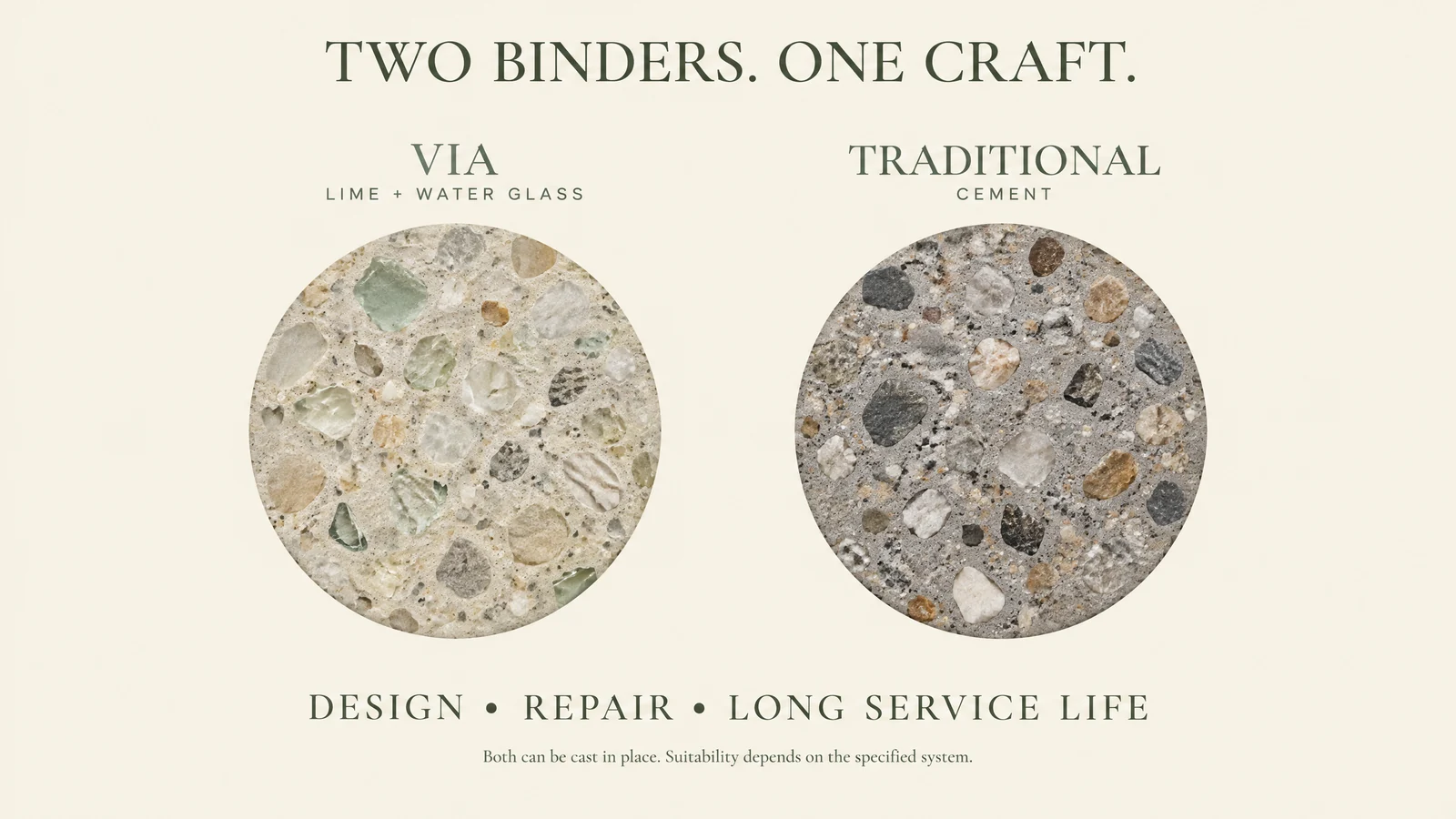
Cast-in-place terrazzo describes production on site: the mix is placed and ground in situ. At first, the term says nothing about whether lime, cement, epoxy resin or another binder is used. VIA is therefore not an alternative to cast-in-place terrazzo as an installation method, but a distinctive binder and processing system within this material family.
Here, we compare VIA lime/sodium-silicate terrazzo with traditional cement-bound cast-in-place terrazzo. Epoxy-resin terrazzo is another, distinct variant and is not equated with cement. Genuine precast terrazzo slabs and ceramic terrazzo-look tiles are different products as well: a similar visual language does not mean the same composition, repairability or installation method. [1][4]
VIA draws on lime-bound Venetian traditions and describes a mineral matrix activated with sodium silicate (water glass). Its distinction is therefore less the invention of terrazzo than the combination of material character, standardised processing and contemporary design options. [1][2]
Refurbishment and build-up height: a thin finish does not automatically mean a thin floor
At doors, stair junctions and existing screeds, every millimetre matters. Depending on the aggregate grade, VIA specifies thin installation depths; for example, the data sheet describes an application of around 10 mm, of which roughly 3 mm are ground away. That leaves an approx. 7 mm finished layer – without primer, levelling, any additional system layers and the load-bearing substrate. Such an example is not a universal minimum thickness for every bespoke mix. [1][2]
Cement cast-in-place terrazzo is not available only as one thick standard build-up either. The NTMA guide describes monolithic toppings of a nominal approx. 13 mm directly on concrete, as well as bonded build-ups with an underbed totalling around 44–57 mm. Above all, these North American reference constructions show that the finish layer and the complete construction must be considered separately. They do not replace planning to the requirements applicable to the project. [4]
For both systems, load-bearing capacity, levelness, moisture and dimensional stability are key checks. Movement joints are planned and carried through. A low-shrinkage matrix does not automatically prevent cracks originating in the substrate; a thin finish is not an independent decoupling layer. This is particularly relevant in older holiday homes with an unknown screed build-up or existing cracks. [2][4]
Installed today, ground tomorrow: what the timing benefit really means
VIA specifies dry grinding after around 24 hours. This is of interest for site coordination: no additional water is introduced during grinding and, with suitable extraction, dust can be controlled. The process is not dust-free, however; filtration equipment, occupational protection and orderly site management remain necessary. [2]
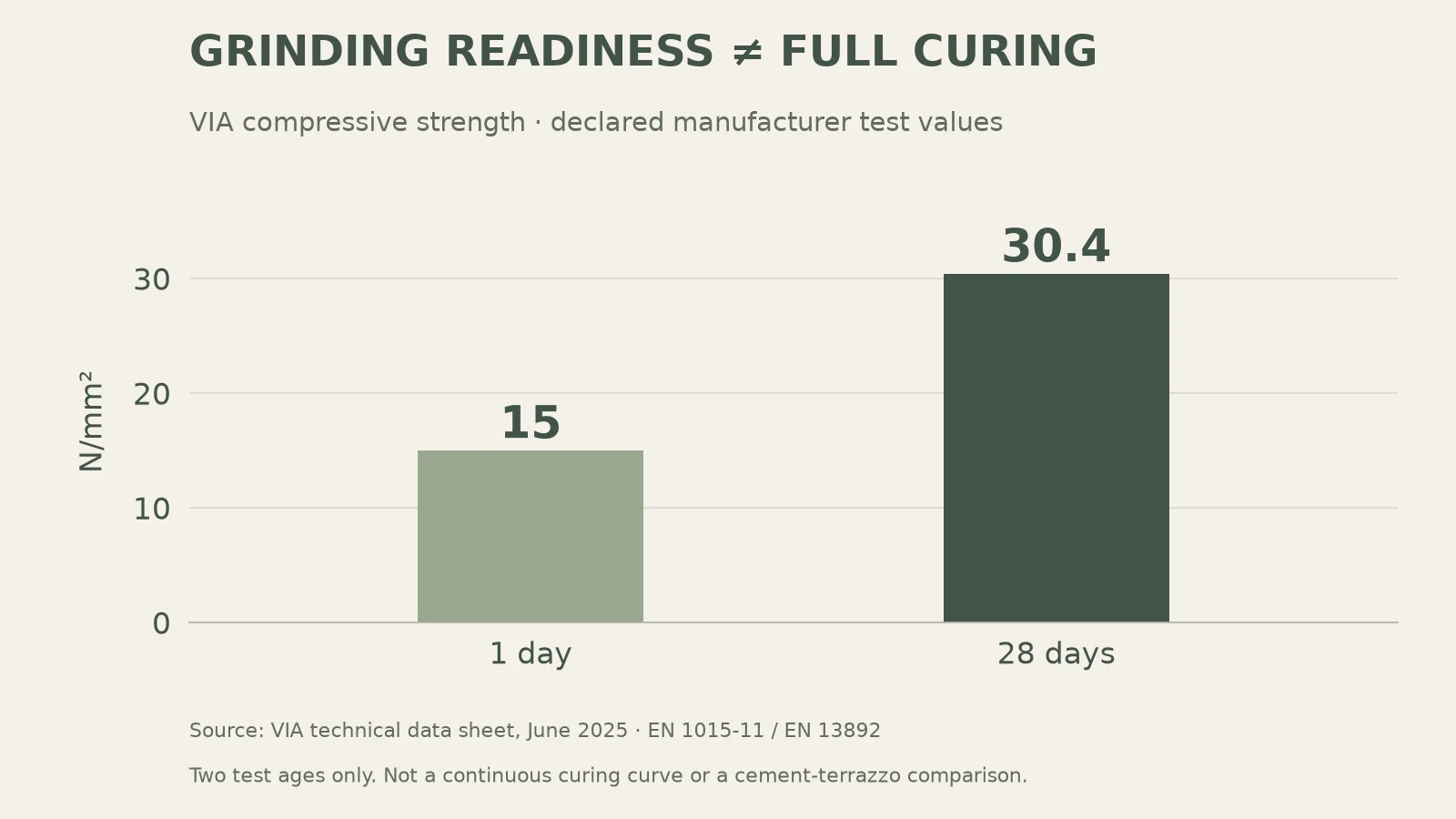
The start of grinding is not the same as full curing or unrestricted load-bearing capacity. The data sheet states a compressive strength of 15 N/mm² after one day and 30.4 N/mm² after 28 days. The graphic shows these two manufacturer test values, not an independent test or a strength comparison with cement terrazzo. A holiday villa should therefore not be released for the next guest changeover solely because of the 24-hour statement. [2]
Conventional cement-bound build-ups are aftercared and ground according to their mix and execution. The right question is not simply, ‘How many weeks does cement take?’, but: which steps, moisture conditions and sign-offs does the proposed system include? Construction time includes substrate preparation, installation, grinding, surface protection and the intended actual use. [4]
New design freedom: from MyTerrazzo to a bespoke interior
For an Algarve villa, terrazzo can be conceived as a connecting architectural language. Warm ivory, sand or grey tones can complement timber, lime plaster and natural stone; larger aggregate grades create deliberately distinctive accents. The colour of the matrix, the type and size of the aggregates, and the grinding finish change the character more than a product name alone. The decision should therefore be made using a sufficiently large sample, not just a screen image.
With MyTerrazzo, VIA offers individually coordinated aggregates and base colours. There are also prefabricated objects, stair treads, wall surfaces, skirtings and worktops, as well as precise transitions between a cast finish and matching single-layer slabs. This gives clients the opportunity to plan the floor not in isolation, but as part of a coherent room concept. Formed components and worktops still require their own detailing, load and surface planning. [1]
Traditional cement terrazzo likewise permits bespoke aggregates, pigments and articulated areas. VIA has no monopoly on creativity here. Its combination of curated mixes, bespoke formulations and rapid grindability is especially interesting. Anyone wishing to use glass, ceramics, regional stone or unusual materials must have the specific mix technically checked. Experimental organic or metallic aggregates must not automatically claim the same properties as a standard mineral formulation. [1][4]
Recycled terrazzo: demolition material becomes a new material story
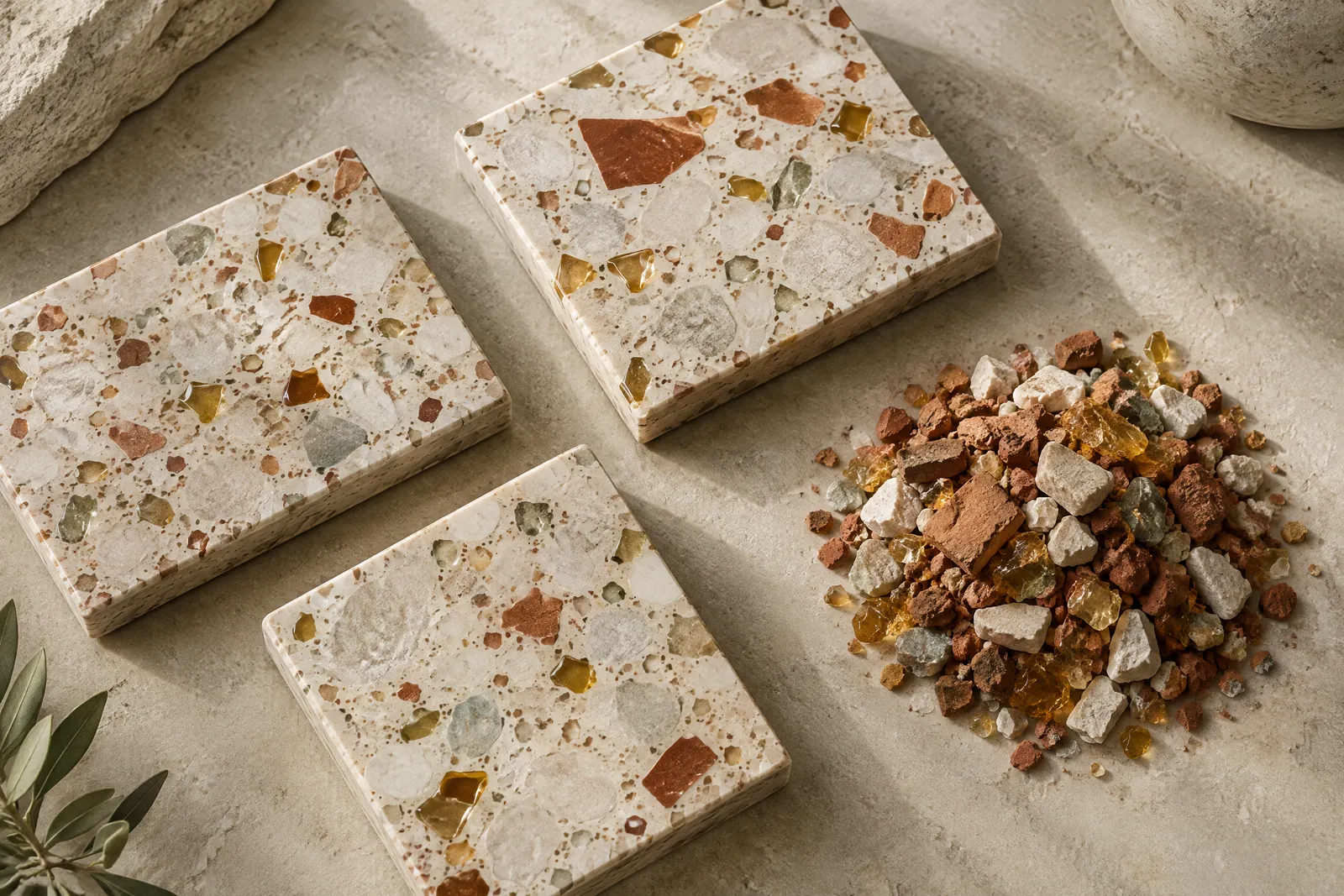
The compelling step in recycled terrazzo is not merely reuse, but visibly building on with materials already at hand. Cleanly processed brick, ceramic, glass or natural stone can become design aggregates. For example, suitable material from a refurbishment could be incorporated into a new interior surface. This is a design possibility, not a promise that every existing floor or every demolition material is suitable. [3]
VIA describes the process through sorting, processing, sampling and agreeing a formulation. Contaminants, coatings and foreign matter must be excluded. The manufacturer page states that recycled mixes typically contain 50–60%, or up to 60%, recycled material. This figure depends on the formulation; the article does not infer a guaranteed proportion for your project or a blanket CO₂ saving from it. [3]
Locally available aggregates can replace virgin material and shorten transport distances. Whether this is actually less expensive and environmentally sound, however, depends on sorting, cleaning, crushing, waste and the routes of all remaining components. A local aggregate does not automatically make an imported complete system local. Nor is recycling exclusive to VIA: cement-bound mineral constructions can also use recycled aggregates and be recovered after removal. [3][8]
‘100% recyclable’ initially describes a manufacturer-stated material property. A closed loop only exists if the material can later be separated and a real regional recipient is available. High-value reuse and use as crushed fill or bearing layer are different outcomes. [3][8]
Environmental aspects without greenwashing: cement-free is not CO₂-free
The absence of Portland cement and epoxy resin is a specific product property. A robust environmental assessment needs more, however. Lime production also requires energy and inherently releases process CO₂ during firing. Sodium silicate likewise entails manufacturing effort. Binder quantities, aggregates, transport, installation, surface protection and later removal must therefore be considered together. The hydrated-lime EPD and specialist literature on alkaline activators explain these assessment factors, but they do not provide a ready-made VIA-versus-cement-terrazzo balance. [5][9]
During use, lime can take up CO₂ again through carbonation. The extent and rate depend on composition, moisture, accessibility and application. This partial uptake is not a blanket climate-neutrality guarantee; it must neither be offset without verification against all manufacturing and transport emissions nor transferred directly from mortar studies to a terrazzo floor. [5]
The research reviewed contains no methodologically equivalent, VIA-specific head-to-head EPD comparison. We therefore state no percentage CO₂ advantage. A fair comparison would need to use the same area, function, service life, system boundary and data quality. The stated very low emissions under EMICODE EC1 PLUS also concern emission characteristics in the product context and must not be equated with a low carbon footprint. [2][5]
For homeowners, a durable, repairable floor that remains suitable over time can be a decisive environmental benefit. An intact existing terrazzo should therefore first be assessed for retention and refurbishment. The most beautiful new recycled floor is not automatically environmentally better if a functioning surface has to be needlessly removed for it. Extending service life and using less replacement material are important principles; they do not guarantee a service life. [8]
Maintenance and holiday letting: beauty needs a clear operating concept
For high-quality rental homes, maintenance is not a side issue. Frequently changing guests, sand, suitcase wheels, spilled drinks and different cleaning teams all meet the same surface. A sensible plan includes dirt-trapping zones, suitable furniture glides, prompt stain removal and a written cleaning protocol for the teams involved.
VIA recommends the coordinated tile and terrazzo soap and expressly warns against acidic cleaners such as vinegar and citric acid. Lime-containing aggregates and the mineral surface can react to acids. Impregnation does not make the floor acid-proof, scratch-proof or maintenance-free either. Surface protection and cleaners must suit the particular formulation and use; aggressive descalers do not belong on terrazzo as a matter of course. [1][6]
A suitable grinding and protection concept allows later refreshing. Depending on the aggregate, pigment and existing material, local repairs can remain visible. Remaining material, formulation data and samples should therefore be documented. For holiday letting, such a maintenance file is often more valuable than a general promise of ‘easy care’. Execution and ongoing maintenance together create the quality that guests actually experience. [1]
What does terrazzo cost? Keep material price and project price distinct
A transparent example: on the research date, VIA lists mix T06054 with 6–8 mm chippings at €99.96 per 25 kg bucket and approx. €99.96/m² of material at the regular layer thickness. The shop lists prices including VAT and excluding shipping. This is a single material offer – not a complete price for an installed floor in the Algarve. Delivery and tax conditions for Portugal must be clarified separately. [7]
For both systems, a quotation should include substrate assessment, removal where needed, levelling, primer, joint planning, material, installation, grinding, finish and logistics. Small areas, stairs, special aggregate grades, recycling preparation and complex junctions change the amount of work involved. Lower raw-material costs in recycling can be partly or entirely offset by sorting and sampling. [3]
Compare the same scope of work, therefore, rather than a bucket price with a fully finished cement terrazzo floor. A robust Algarve calculation needs the project location, floor area, intended use, substrate information and an agreed sample build-up. SteinWert prepares the planning on this basis; a universal per-square-metre rate would be misleadingly precise here.
Algarve specifics: plan heat, coastal conditions and pool areas correctly
The VIA data sheet specifies application temperatures of +10 to +25 °C and requires protection from high temperatures, draughts and direct sunlight. Particularly on summer construction sites in the Algarve, it is therefore necessary to plan not only a date but a suitable indoor and application climate. The open time of around 30–45 minutes depends on temperature; a shaded interior and appropriate work organisation are not mere matters of comfort. [2]
An interior-suitable terrazzo formulation is not automatically approved for an unprotected pool surround, a permanently wet shower or a pool basin. Waterproofing, falls, drainage, joints, wet slip resistance and water chemistry are separate requirements. The same applies to cement terrazzo: a build-up described for exterior use does not replace evidence for the specific polished finish and intended wet use. [4][7]
For a high-quality holiday villa, it is therefore often sensible to plan the living area and pool/spa areas as technically separate but visually coordinated material schemes. Combining terrazzo indoors with natural stone or ceramics outdoors can create a calm overall effect without assigning every function to one material without verification.
Which terrazzo suits your project?
Assess VIA specifically
If you are seeking individually designed interiors, a suitable thin-finish solution or a sampled recycled formulation, and the substrate and application climate can be managed.
Assess cement cast-in-place terrazzo specifically
If an established cement build-up, a suitable existing formulation or a specifically detailed exterior system is required. Here too, detail planning, joints and maintenance decide.
Retain the existing floor first
If a serviceable terrazzo already exists: cleaning, regrinding, repair and renewed protection may be more sensible than complete replacement.
Frequently asked questions about VIA and cast-in-place terrazzo
Is VIA terrazzo genuine cast-in-place terrazzo?
Yes. The mix is placed and ground on site. ‘Cast-in-place terrazzo’ describes the production method; VIA uses a lime/sodium-silicate binder instead of a traditional cement matrix.
Is VIA inherently more sustainable than cement terrazzo?
That cannot be claimed as a general rule. Being free from cement and epoxy resin, using tested recycled aggregates and being capable of refurbishment are interesting properties. A CO₂ advantage, however, requires comparable lifecycle evidence for the complete build-up.
Can material from my Algarve villa be reused?
Possibly. Suitable, contaminant-free material must be sorted, processed and sampled. Composition, aggregate grade and formulation require technical approval; not every demolition material is suitable.
Is the floor ready for holiday guests after 24 hours?
Not automatically. The approx. 24 hours refer to possible dry grinding. Use, surface protection and curing must be coordinated and approved separately.
Can the same VIA finish also be used in the pool and on the terrace?
A blanket approval cannot be derived from the documentation reviewed. Wet and external applications need separate evidence for waterproofing, slip resistance, water chemistry and the complete system build-up.
What does SteinWert need for an initial assessment?
Project location in the Algarve, approximate area, indoor/outdoor use, photos of the existing conditions, known substrate data and your timeframe. Substrate assessment and sampling follow for planning.
Sources and technical context
Manufacturer information is identified as such. Specialist sources explain general construction and assessment principles; their values are not transferred without verification to an Algarve project. Research: 21 October 2026.
- [1]VIA – Terrazzo: System, Gestaltung und Verarbeitung
- [2]VIA – Technisches Datenblatt, Stand 06/2025
- [3]VIA – Recyclingterrazzo: Aufbereitung und Rezepturen
- [4]NTMA – Terrazzo Systems Reference Guide 2023
- [5]EuLA – Hydrated Lime Environmental Product Declaration
- [6]VIA – Pflege und Reinigung
- [7]VIA – T06054: Produkt, Preis und Leistungsumfang
- [8]EUPave – Long service life and recycling (general principles)
- [9]LCA study – Variability in constituent production of alkali-activated and Portland cement concrete