
Stone Care for Holiday Homes in the Algarve
Stone care for holiday homes in the Algarve begins by retaining what is sound. Dullness, stains or deposits are not automatic reasons to replace a surface. Establish material, finish, grout, moisture and use first; then choose care, cleaning, restoration or a separate building repair.
Enquire about your project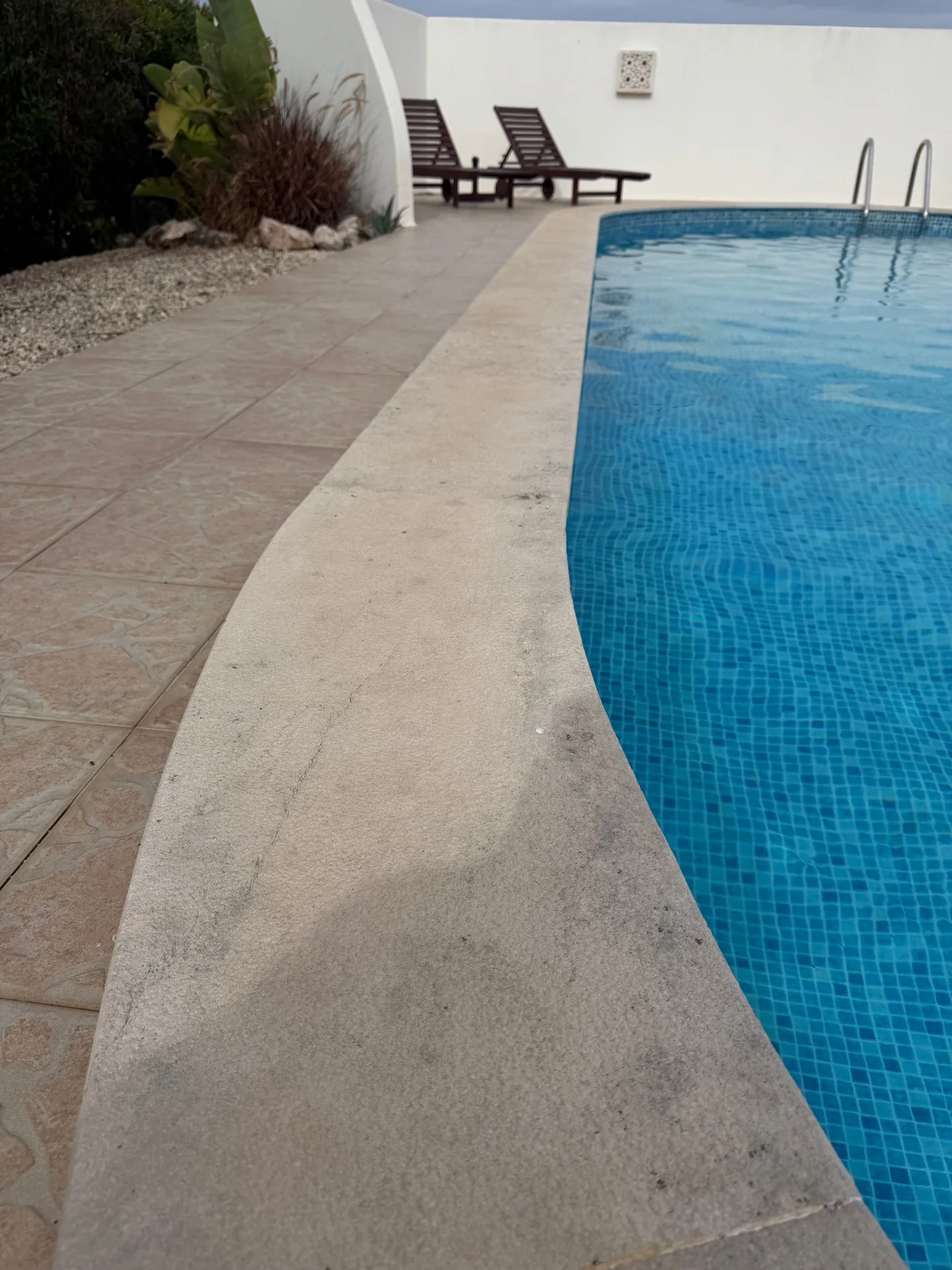
SteinWert helps owners apply that sequence to terraces, pool copings and interior floors—before the season, a renovation or purchase of an older home. The aim is not a generic cleaning promise, but a reasoned decision that protects the home’s fabric and practical upkeep.
Preserve before you replace
A deposit, a dull traffic lane or an isolated stain does not prove a floor needs replacement. Removable residue, absorbed stains, acid etching, genuine scratches, loose edges and moisture call for different choices. Photographs, known material details and past products support a first review; inspection or a test area may follow.
Material-compatible cleaning preserves fabric when a change sits on the surface or can be safely removed. Mechanical honing or polishing is considered only for eligible mineral surfaces with a suitable construction, thickness and damage pattern. Cracks, movement, hollow areas and leaking junctions need a separate repair plan.
Terraces and pool copings: identify the cause first
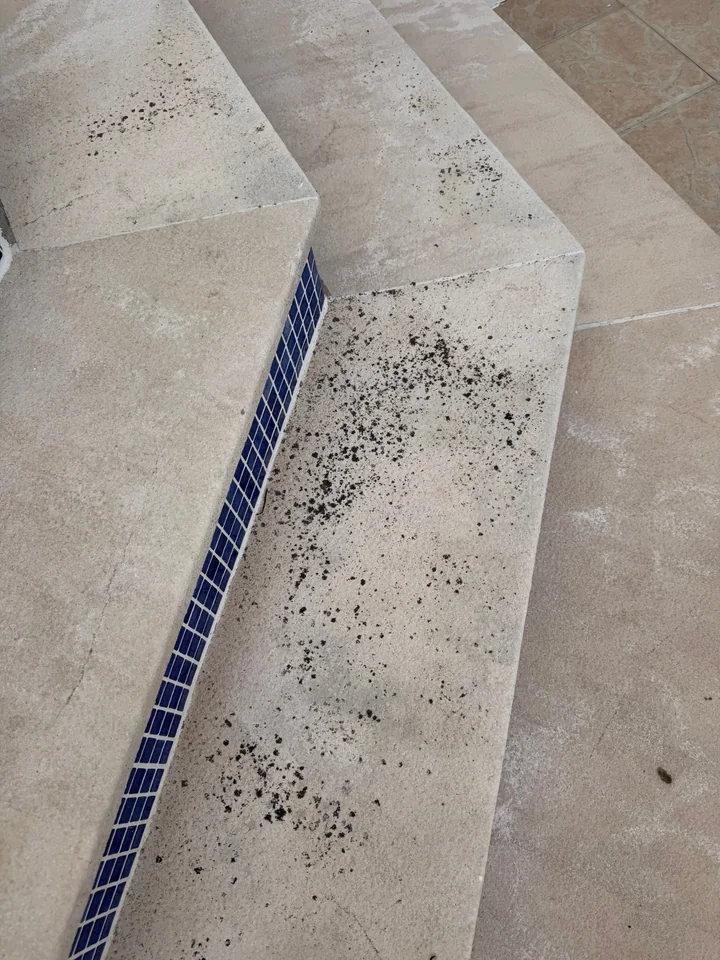
Salt air, sun, fine sand, irrigation, pool water and sunscreen meet on Algarve surfaces. Limescale, cosmetic residue and dirt can look alike but react differently. Green or dark marks may be biological growth; white powdery veils may be mineral efflorescence driven by water movement and evaporation. They are not the same condition.
Review the surface, grout, drainage, moisture routes and, where useful, an inconspicuous test area before treatment. Acid can attack limestone, marble and cementitious grout; uncontrolled pressure can damage softer faces and joints. Pool decisions must also consider drainage, weather and slip safety.
Assess interior floors and grout separately
Inside, grease, drinks, cleaning films, sand and furniture marks are common. A dark patch may be absorbed; a smeary film may sit on top. Dull rings on marble or limestone after acidic liquids can be etching. Genuine scratches and chemical change do not disappear through cleaning alone.
Cementitious, resin and elastic silicone joints have different functions and tolerances. Cleaning can remove loose residue but cannot restore sealing. The selected cleaner must suit covering and grout; loose, cracked or leaking perimeter joints require repair, not surface protector.
Clean, protect or refinish according to the material
Limestone, marble, travertine, granite and terrazzo differ in absorbency, acid sensitivity and restoration options. Eligible stone or terrazzo may be mechanically honed after assessment; ceramic glaze cannot be ground like marble. Metal transfer on ceramic may be removable, while damaged glaze calls for another response.
Exposed screeds and coated floors need a system and compatibility test before cleaning, protection or abrasion. On a dry, absorbent substrate, impregnation may ease routine care; it is not waterproofing, a cure for moisture sources or a slip-resistance certificate. Protection follows cause, drying and material approval.
Renovation with terrazzo and electric underfloor heating
VIA terrazzo with electric underfloor heating can be part of renovating an older home, but only in a manufacturer-compatible assembly designed for the property. Check and approve load-bearing capacity, insulation or decoupling, substrate, build-up and required dryness before installation.
Electrical design, connection and commissioning belong to a qualified installer under local requirements. No universal low-cost or energy-saving claim follows: heat demand, building, insulation, use and electricity supply matter. Assess the existing floor for retention or appropriate restoration before replacement.
Season planning, access and a substantiated quote
For personal use or rentals, plan visual checks before the main season and after heavier use, rather than a fixed care promise. Allow for good-light photographs, water and power, clear work zones, furniture moves, drying time and guest changeovers. Projects can be assessed in Lagos, Loulé, Vilamoura, Albufeira, Tavira and elsewhere in the Algarve.
SteinWert is headquartered in Potsdam, Germany. The Algarve is a project region, not a Portugal office; availability and rapid response are not guaranteed. A quote depends on material, condition, area, access, result, logistics and water and power. Email hoo@stein-wert.de, subject “LP Algarve”, or WhatsApp +491723837812.
Frequently asked questions
Does my terrace need deep cleaning every year?
Not necessarily. A seasonal visual review is useful; the need for cleaning or protection depends on the material, use, pool exposure, shade, drainage and actual condition.
Are dark dots at the pool coping definitely algae?
No. They may be linked to biological growth, but other causes are possible. White mineral efflorescence is a different condition and needs a different cause assessment.
Does impregnation make a surface waterproof and slip resistant?
No. Suitable impregnation does not replace waterproofing and is not a slip-resistance certificate. Suitability, dryness, finish and use must be assessed first.
Can every scratched surface be ground?
No. Eligible natural stone or terrazzo may be restorable; ceramic glaze cannot be ground like marble. The construction and damage pattern determine the appropriate route.
How do I obtain a project quote?
Please send the property location, approximate area, use, overview and detail photographs, and any known material information. The technical scope, access and sensible next review can then be considered.